400 Stonebrook Pkwy STE 902, Frisco TX 75036
What is harm reduction strategy?
Harm reduction : Meeting People Where They Are
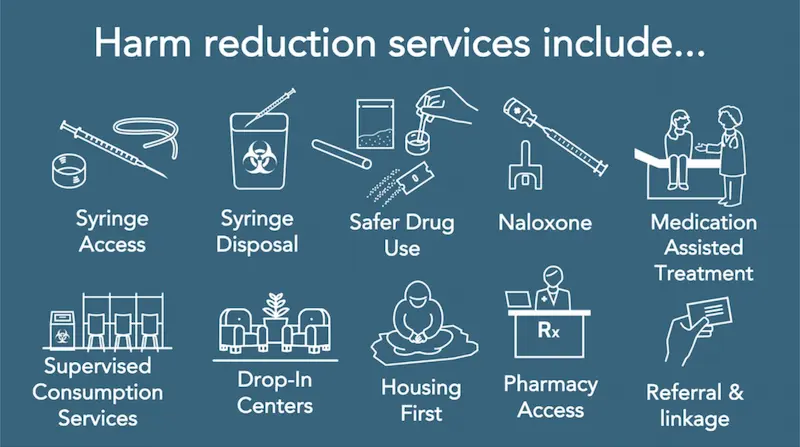
Image depicting different Harm reduction strategies employed by Medivira in Frisco TX
Harm reduction is a set of practical strategies aimed at reducing the negative consequences of risky drug use behaviors.People will at times make risky choices with their drug use.They may seek help for treatment, but still continue to use drugs. Rather than demanding that people stop a behavior before they can receive help, harm reduction is based on the premise that we will save more lives, prevent more disease, and protect more dignity if we work with them rather than against them. It is not the opposite of abstinence; it is the recognition that abstinence is one outcome on a long spectrum of healthier choices, and that every step in that direction matters.
Core principles guiding harm reduction strategies:
1) Pragmatism: acknowledging that risky behaviors exist and focusing on minimizing their harm rather than denying their reality.
2) Humanism : treating people as full human beings deserving of dignity, autonomy, and respect, regardless of what they use or how they live
3) Incrementalism : understanding that change is rarely linear, and that small improvements (using a clean needle, carrying naloxone, calling a friend before using alone) are meaningful victories in their own right
Together, these principles shift the question from "how do we get this person to stop?" to "how do we keep this person alive and well enough to choose a different path when they're ready?"
The six core practice areas include:
1.Safer practices which include education and support describing how to reduce risk.
Examples: syringe services programs, safer smoking supplies distribution, and Drug checking services let people test substances for fentanyl and other contaminants before use -fentanyl and xylazine test strips. Supervised consumption sites provide medically monitored spaces where overdoses can be reversed on the spot
2.Safer settings, including access to safe environments to live, find respite, practice safer use, and receive supports that are trauma informed and stigma free.
Examples: include day centers and social spaces that offer harm reduction services and access to safe and secure housing.
3.Safer access to health care, by ensuring access to person-centered and nonstigmatizing care that is trauma informed.
Examples including low-barrier opioid treatment services and mobile and take-home methadone services. Naloxone distribution puts the opioid-overdose-reversal drug directly into the hands of users, families, and community members, where it has reversed hundreds of thousands of overdoses
4.Safer transitions to care or connections and access to harm-reduction-informed and trauma-informed care and services.
Examples include expansion of telehealth and medication access and treatment on demand.Medication-assisted treatment (MAT) with Methadone or Buprenorphine stabilizes lives and dramatically reduces mortality. None of these strategies require a person to be "ready to quit" — they only require that the person wants to stay alive
5.Sustainable workforce and field, including resources for maintaining a skilled, well-supported, and appropriately managed workforce.
Examples include offering living wages and essential benefits for harm reduction workers and training and technical assistance for providers.
6.Sustainable infrastructure, or resources for building and maintaining a revitalized and community-led infrastructure to support harm reduction best practices and the needs of PWUD.
Examples include hiring PWUD to inform policy at agencies and promoting education on the value of harm reduction services.
The evidence base for these interventions is robust and, in many cases, decades old. Syringe services have been shown repeatedly to reduce infectious disease transmission without increasing drug use.
Naloxone access correlates with significant declines in overdose deaths.
Supervised consumption sites in cities from Vancouver to Sydney have operated for years with zero on-site fatalities and have been linked to higher rates of treatment entry. Medication-assisted treatment is considered the gold standard for opioid use disorder by virtually every major medical body.
Despite this, harm reduction services are still underfunded and politically contested in many places, often because they are misunderstood as "enabling" the very behaviors they are designed to make safer.
Although harm reduction emerged primarily from communities of drug users and the early AIDS response, the framework now reaches far beyond illicit substances. Designated-driver campaigns, seatbelt laws, condom distribution in schools, nicotine replacement therapy, and even helmet requirements for cyclists are all, fundamentally, harm reduction. So is teaching teenagers about safer sex rather than abstinence alone, providing fentanyl test strips at music festivals, and offering managed alcohol programs for people with severe alcohol use disorder. The underlying logic is the same in each case: people are going to drive, have sex, drink, and take risks, and a society that meets that reality with information and tools will be healthier than one that meets it with shame.
Ultimately, harm reduction asks us to hold two truths at once: that some behaviors carry real risks worth reducing, and that the people engaged in those behaviors are worth caring for unconditionally. It is not a surrender to addiction or recklessness but a refusal to let the perfect be the enemy of the good, and a recognition that the road to recovery, when it comes, is almost always walked by someone who first stayed alive long enough to walk it. In a moment when overdose deaths remain near historic highs and stigma still keeps people from seeking help, harm reduction is not a fringe philosophy. It is a lifeline, and one of the most evidence-backed, human-centered tools we have.
Medivira provides addiction medicine and mental health services under the care of a licensed physician. This website is for informational purposes only and does not constitute medical advice.If you are experiencing a medical emergency, call 911
Timings: Same-day appointments
Telehealth:Mon to Sun : 7am–9pm
In-Person: Mon, Wed, Fri : 1pm–5pm
24/7 Text Support
Privacy Policy | Terms & conditions | Last updated: May 2026
© 2026 Medivira. All rights reserved.